Saturday, September 21, 2024

Secret Insider Tips to Get Rolled Coins from Banks

One of the most rewarding ways to collect coins is finding rare coins in regular circulating coinage from the bank. You can't go wrong with searching bank-wrapped rolls of coins! However, you will need patience. You buy the coins at face value, search them for errors, varieties, and rare coins, and then sell the rejects back to the bank to get more coins to examine! You only have to invest your time in using this risk-free methodology. But it's not as easy as you think. In addition to knowing what varieties, errors, and rare coins to look for, you must deal with the fact that a bank is an institution based upon making a profit. Knowing how to overcome this limitation will help you get the rolls of coins you need to search through. Additionally, demand for coins varies with the economy. When demand is high and there is a coin shortage, no matter what you do, a bank teller may be reluctant to sell you a large volume of rolled coins.

Most Bank Wrapped Coins Come from the Federal Reserve

Unfortunately, there's a glitch. Most banks don't like to sell rolled coins to their retail customers. Additionally, to get the bank to acquire rolls of coins fresh from the United States Mint is virtually impossible. Part of the problem lies in how the Federal Reserve System distributes coinage to the banks. The Fed charges the banks a fee to place special orders for coins and currency unless the coin qualifies as a "Commemorative Issue" and has a designated Special Ordering Period. The Statehood Quarters and the Presidential Dollars qualified under this designation when they were first released.

However, even if you can get your bank to special-order rolled coins, there is no guarantee that the Federal Reserve will send your bank mint-state coins! The Fed isn't required to honor requests for mint-state (what they call "new") coins, but they say they do when inventory levels allow. The Federal Reserve always sends out "mixed" (circulated or used) coinage first.

The point here is that even if you found a bank willing to cooperate and order new coins for you, they might not get them! The result is that the bank fills out a Special Request form, possibly paying additional fees, and then doesn't understand what you wanted anyway, resulting in unhappy customers. Furthermore, if it is an odd denomination, like a half dollar, the bank may be stuck with them for several months or years since very few customers asked for them. The banks' solution to this problem, typically, is to avoid doing any special ordering for coins at all.

Finally, banks in smaller markets may not be ordering directly from the Federal Reserve Bank. Instead, the Fed may contract with a large regional bank to distribute their coin and paper money into smaller markets. Since the bank is acting as a middleman, this increases the cost of handling the rolled coins. The large regional bank also collects a fee from the ordering bank for handling these special requests.

How to Crack the Bank's Refusal to Sell Rolled Coins

Now that you understand the reasons why banks are reluctant to order and provide rolled coins, you can learn to work with them to get what you need. Whether you are looking for mint-state rolls of Sacagawea Dollars or circulated pennies so you can sort out the copper from the zinc, the first step is to define your goal.

If your goal is to get mint-state coins, your best bet is a smaller, full-service bank that doesn't usually deal with a lot of merchant accounts. Such banks are typically positioned as higher-end "enterprise banks," and don't have the free types of checking and savings accounts. But if you're a hard-core coin searcher or like to lay up a lot of mint-state rolls, a bank of this sort will be the type most likely to order and get "new" coins. They will most probably pass the fees along to you, too, and having an account at the bank will be mandatory. Source


Wednesday, September 18, 2024

How Much Is a $2 Bill Worth?

How much is a $2 bill worth today? The answer could surprise you. Throughout history, the $2 bill tried to find its place in the American banking system. The bills were never widely circulated or accepted by the American public and most cash drawers in a standard register don't even have a spot for them. However, there are a few banknote collectors that specialize in obtaining certain $2 bills. 

History of the $2 Bill

The $2 bill has a long history that truly began in 1775 when the Continental Congress issued $2 “bills of credit” for the defense of America. Since then, the $2 bill has gone through changes in size and design in unsuccessful efforts to help it gain popularity.

Introduction of Large-Size $2 Bills

The United States first printed $2 bills as large-size (approx. 7-3/8 inches by 3-1/8 inches) Legal Tender Notes in 1862. The Federal Bureau of Engraving and Printing did not produce these notes. The National Bank Note Company engraved both the faceplates and the backplates for the series. Alexander Hamilton is featured on the face while the back features a series of ornate scrolls with the denomination "2" prominently displayed in each corner.

The center of the backplate features two concentric circles of 2's, enclosing the redemption statement of "This note is a LEGAL TENDER for all debts public and private except duties on imports and interest on the public debt and is receivable in payment of all LOANS made to the United States."

Determining the Value and Worth of a $2 Bill

Just like coins, several factors determine the value of a $2 bill. The main two factors are rarity and demand. Most $2 bills have very low printages because they were not very popular with the American public and did not circulate widely. However, many people think that a $2 bill is valuable and tend to save them, resulting in a probable large supply of well-preserved $2 bills housed around the country.

Conversely, $2 bills are not popular among banknote collectors. Therefore, the demand is low while there is likely an ample supply to meet the banknote collector requirements. Additional premiums are carried on banknotes that have a star in the serial numbers. In addition, the Treasury officer signatures and issuing Federal Reserve branches are taken into consideration when valuing a $2 bill.

Large-Size

Most large-size $2 bills issued from 1862 through 1918, are highly collectible and are worth at least $100 in well-circulated condition. Uncirculated large-size notes are worth at least $500 and can go up to $10,000 or more.

Small-Size

Small-size $2 notes from 1928 to today are more common and fall into the following categories of circulated and uncirculated. The series and its category determine a potential value. Source


Sunday, September 15, 2024

What Is a Gold Certificate?

A Gold Certificate is a paper note or bill issued by the United States government that represents a specified claim for a particular dollar value of gold or gold bullion deposited in the United States Treasury. Unlike other notes issued by the United States government, these notes were issued as a convenience rather than a political or economic strategy. Therefore, a majority of the notes issued were of higher denominations.

History of the Gold Certificate

The first Gold Certificates were issued under the Banking Act of March 3, 1863. Generally, Gold Certificates are divided into two groups: large size and small size. Large size currency measured 3.125 x 7.4218 inches, and small size currency measured 2.61 x 6.14 inches. The following series were issued until production was suspended in 1934:

Large Size Denominations

  • Series 1865: $20, $100, $500, $1,000, $5,000, $10,000 
  • Series 1870-75: $100, $500, $1,000, $5,000, $10,000
  • Series 1882: $20, $50, $100, $500, $1,000, $5,000, $10,000
  • Series 1888: $5,000, $10,000
  • Series 1900: $10,000
  • Series 1905 & 1906: $20
  • Series 1907: $10, $1,000
  • Series 1913: $50
  • Series 1922: $10, $20, $50, $100, $500, $1,000

Small Size Denominations

  • Series 1928: $10, $20, $50, $100, $500, $1,000, $5,000, $10,000
  • Series 1934: $100, $1,000, $10,000, $100,000

Originally, paper money issued in the United States was printed and distributed by individual banks. If the bank failed, the notes became worthless. Eventually, people did not trust paper currency and demanded gold or gold coins to complete financial transactions. 

For large transactions, gold and gold coins proved to be bulky and difficult to transport. Additionally, transporting large amounts of gold was very risky because it was hard to conceal. Gold Certificates were created to restore trust in paper currency and facilitate larger financial transactions. Gold Certificates circulated widely alongside other paper currency throughout the United States for years. Because a majority of them were used to complete commercial transactions, many of them are still in good condition.

The Treasury Department maintained a large number of gold coins and gold bullion in their inventory to back these notes that were issued. When the United States was removed from the gold standard by President Roosevelt in 1934, he required that all citizens turn in their Gold Certificate for silver coins or replacement paper currency.

On December 13, 1935, a fire in the United States Post Office in Washington, D.C. triggered a series of events where postal workers were trying to save documents from the fire. A box of canceled Series 1900 $10,000 Gold Certificates were thrown out the window. The box burst open, and people scrambled to collect them. Much to their dismay, the canceled bills were worthless. Although they are still considered stolen property because they are worthless, the United States government does not prosecute anybody possessing them.

Are Gold Certificates Legal Tender Today?
Gold Certificates are no longer redeemable for gold coins or gold bullion. However, all gold certificates are considered legal tender and can be redeemed at any financial institution for their face value in equivalent current coin or paper money. However, if the Gold Certificate was redeemed, it was canceled by punching a series of holes in the note that spelled the word CANCELED. These notes are not redeemable at face value. Source

Thursday, September 12, 2024

Coinage Act of 1792

The Coinage Act of 1792 established a national mint located in Philadelphia. Congress chose decimal coinage in parts of 100, and set the U.S. dollar to the already familiar Spanish milled dollar and its fractional parts (half, quarter, eighth, sixteenth). This resulted in coins of the following metals and denominations:

  • Copper: half cent and cent
  • Silver: half dime, dime, quarter, half dollar, and dollar
  • Gold: quarter eagle ($2.50), half eagle ($5), and eagle ($10)

In 1792, during construction of the new Mint, 1,500 silver half dimes were made in the cellar of a nearby building. These half dimes were probably given out to dignitaries and friends and not released into circulation. The Mint delivered the nation’s first circulating coins on March 1, 1793: 11,178 copper cents.

These new cents caused a bit of a public outcry. They were larger than a modern quarter, a bulky size for small change. The image of Liberty on the obverse showed her hair steaming behind her and her expression “in a fright.” The reverse featured a chain of 15 links, similar to the Fugio cent. However, some people felt that it symbolized slavery instead of unity of the states. The Mint quickly replaced the chain with a wreath, and a couple months later designed a new version of Liberty.

Although individual states were no longer authorized to produce coins, legislation temporarily allowed certain foreign coins to continue to circulate until the Mint released enough coins to handle the country’s needs. Source

Monday, September 9, 2024

Coin Collecting 101: Master The Art Of Coin Collecting


Rod Gillis, former Education Director at the American Numismatic Association, shares valuable insights for those new to coin collecting. In this video, Gillis discusses one of the most crucial decisions in a collector's journey—how to collect. With years of experience and a passion for engaging with collectors, he explores various innovative ways to approach the hobby.

Some collectors focus on United States coins, while others are drawn to world coins or coins from specific locations or significant years, such as the year of their birth. There are also enthusiasts who collect stock certificates and paper money, whether it features unique designs like a horse or a distinctive color like purple. The possibilities in collecting are as vast as a collector’s imagination and budget.

Gillis outlines the two most popular methods of coin collecting: by type and by set. Collecting by type involves seeking the finest example of specific coin denominations, such as Barber half dollars, Liberty seated half dollars, or Walking Liberty half dollars. Collecting by set is the more common approach, where collectors aim to acquire all the years and mint variations of a particular coin.

While collecting by set can be incredibly rewarding, Gillis advises newcomers to start with less challenging sets to gain experience before tackling more difficult collections. For instance, assembling a set of Jefferson nickels or Roosevelt dimes is an easily accomplished and cost-effective way to begin a collecting journey. He cautions against starting with challenging sets like Morgan Dollars, which can be financially demanding and potentially discouraging for new collectors.

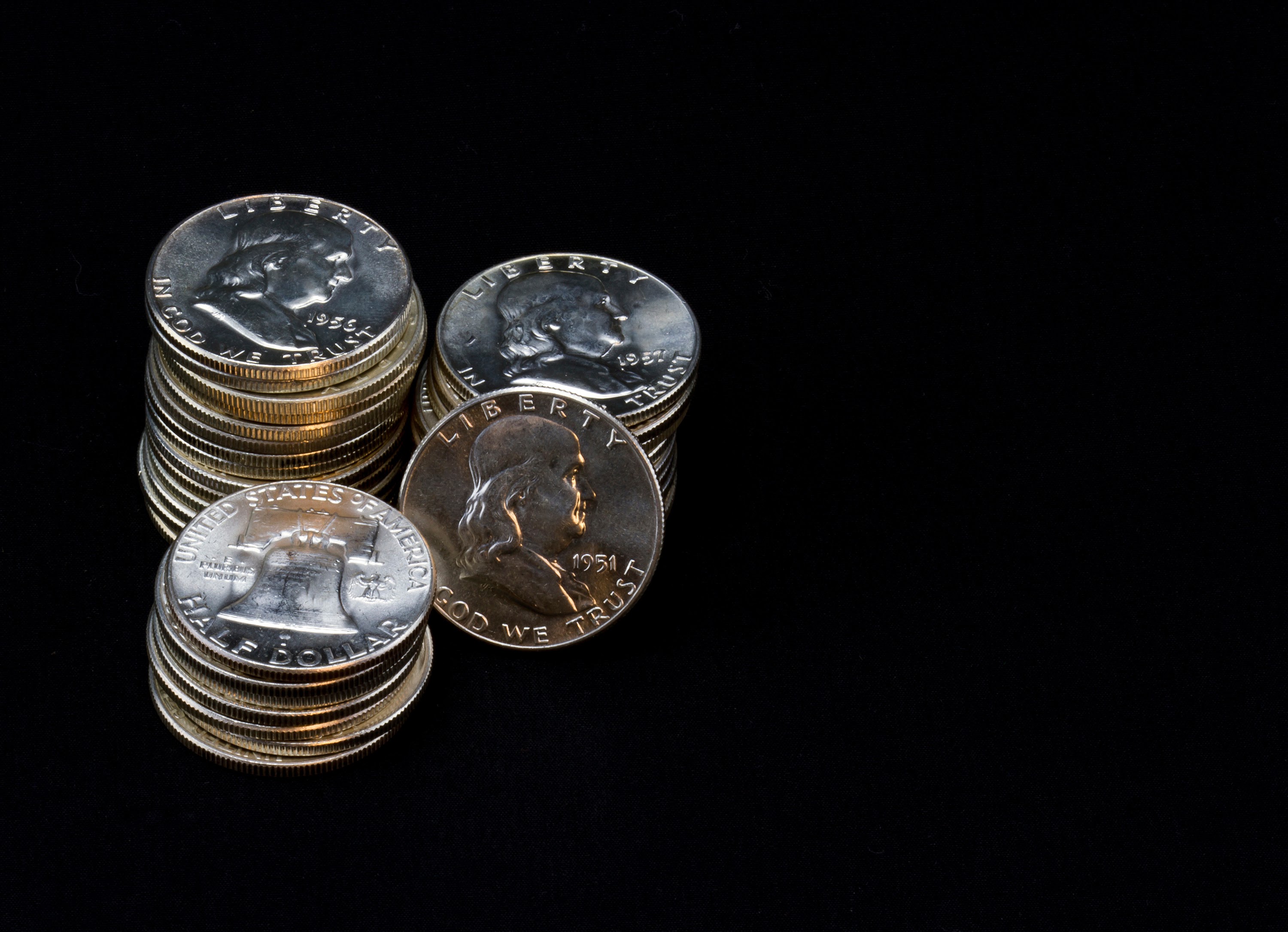
For those seeking a collection with more appeal, Gillis suggests assembling a set of Franklin half dollars, all made of silver and no longer found in circulation. This provides a satisfying collecting experience without a significant financial commitment. 


Friday, September 6, 2024

1976-D Quarter


Do You Have This Valuable Quarter? If you have this quarter it can be worth quite a bit of money! Check your collection today.


Tuesday, September 3, 2024

Franklin Half-Dollar

The Franklin half-dollar was produced from 1948-1963. Nellie Taylor Ross was the director of the Mint at that time. She was a long-time admirer of Benjamin Franklin and wanted to see him on a coin. Though he was considered for the dime mint, officials thought the half-dollar was a better fit, but he did not like the idea.

The designer of the coin was John R. Sinnook, he was the second Chief engraver for the US Mint, but he died and his work was taken over by Gilroy Roberts.

Unlike most US coins, the Eagle on the Franklin half-dollar was an afterthought. This design wasn't added until after the Coinage Act of 1873 which demanded one be present on all denominations.

The Franklin half-dollar was struck at the San Francisco Mint, the Denver Mint and the Philadelphia Mint, however, they were only struck at the San Francisco Mint from 1948-1954. They started making proofs in 1950, two years after the first coins were struck. Source